
Hot Weather and Dogs: Keeping Cool at Home and Knowing When It Matters
- TDFM

- Jun 28
- 6 min read
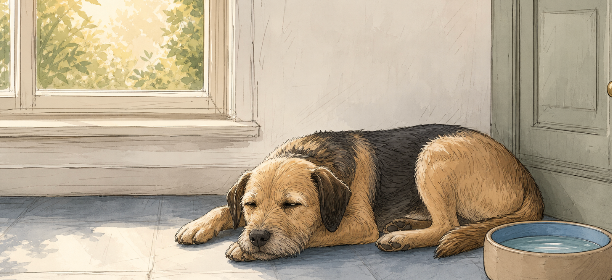
Warm weather is genuinely lovely. For most dog owners, though, a sunny afternoon involves at least one moment of mild guilt — the dog is flat out on the tiles, panting steadily, while you sit in the garden with a cold drink wondering if you've misjudged things. You probably haven't. But it is worth understanding why heat hits dogs differently to us, and what a few small adjustments can do.
The practical side is worth covering properly: what happens in a dog's body when it gets too warm, the everyday habits that create problems without owners realising, the hot pavement risk that is easy to underestimate, and what to do if you think your dog is struggling. This is general information rather than a substitute for veterinary advice — if you are worried about your dog, contact your vet.
Why Heat Hits Dogs Differently
Humans cool down mainly by sweating across the skin. Dogs cannot do this. They regulate their temperature primarily through panting, which works by evaporating moisture from the tongue and respiratory tract, and they have a limited ability to sweat through their paw pads. It is a less efficient system, which means they heat up more quickly and cool down more slowly than we do.
Certain dogs face additional challenges in the heat. Flat-faced breeds — including Bulldogs, Pugs and French Bulldogs — have restricted airways that make panting less effective. Older dogs, overweight dogs and those with thick or double coats also struggle more than average. If your dog falls into any of these categories, extra caution during warm weather is advisable; your vet can tell you what that means specifically for your dog.
Understanding the basic mechanism matters because it changes what you notice. A dog who is getting too warm may not look dramatically distressed at first. Knowing that panting is doing a lot of heavy lifting — and that it has limits — helps you take early signs seriously rather than waiting until something looks obviously wrong.
Everyday Human Habits That Are Harder for Dogs in the Heat
Most of the situations that create problems for dogs in summer are not dramatic. They are ordinary decisions that work perfectly well in October and quietly become a problem in July.
Walking at the usual time is the most common one. A 10am walk that was fine in spring can fall right in the middle of peak heat by midsummer. Dogs tend to keep going because they want to keep going — they are not going to stop and explain that they are struggling. The walk feels the same from your end; it does not feel the same from theirs.
Leaving a dog in a car, even briefly, is one of the most serious warm-weather risks there is. Temperatures inside a parked car can rise extremely quickly even on a moderately warm day, and cracking a window makes very little difference. If the dog cannot come with you, it is safer to leave them at home.
Outdoor events and summer days out require a bit more thought than usual. Shade and water are not always guaranteed at festivals, fairs or busy parks. A collapsible water bowl takes up almost no space and removes one variable entirely — it is the kind of thing that feels excessive until the one day it isn't.
The general principle is that a dog who coped well on a warm day in April is not necessarily well-equipped for a hot day in August. The temperature gap between the two can be significant, and it is easy to carry assumptions across without noticing.
The Hot Pavement Problem
This one catches people out because the air temperature feels reasonable and the pavement looks like just a pavement. In direct sun, tarmac and paving surfaces absorb and retain heat, reaching temperatures well above the ambient air temperature — hot enough to cause real damage to paw pads.
A practical test recommended by the Kennel Club is the seven-second hand test: place the back of your hand on the pavement surface. If you cannot hold it there comfortably for seven seconds, it is too hot for your dog's paws.
The straightforward alternatives are to walk in the early morning or evening when surfaces have had time to cool, and to choose grass or shaded paths where possible. Parks, woodland paths and fields stay considerably cooler underfoot than pavements in full sun. Most dogs are not going to complain about this particular adjustment.
If you notice your dog limping, licking their paws excessively or reluctant to walk after time on hot surfaces, contact your vet. Paw pad burns are painful and can be slow to heal.
Keeping Dogs Cool at Home
Fresh water, available at all times, is the starting point. If your dog moves between rooms or spends time in the garden, a single bowl in the kitchen may not be enough — multiple bowls mean they do not have to travel far for a drink when they are already warm.
Shade and airflow matter indoors too. A room that feels cool in the morning can become very warm by mid-afternoon once the sun has moved round. A cool, shaded resting spot away from south-facing windows — ideally on a stone, tile or wooden floor — gives a dog somewhere to self-regulate without needing your intervention.
Cooling mats are worth considering. They work by absorbing body heat and are available from most pet retailers. Some dogs take to them immediately; others ignore them with considerable commitment. If yours declines to engage, move on to other options without taking it personally.
Dogs who enjoy water often appreciate a paddling pool or garden hose on warm days. For those who do not, it is not worth the stress of persuasion — there are other ways to keep things comfortable.
Fans are useful for circulating air but they do not cool dogs in the same way they cool humans. Because dogs do not cool through skin sweating, a breeze has less direct effect than it would on us. Fans work better alongside cool water, shade and reduced activity than as a standalone solution. Avoid exercising your dog in the garden during the hottest part of the day even if they seem keen — enthusiasm and good judgement are not always the same thing.
Signs Your Dog May Be Overheating
Signs to watch for include heavy or laboured panting that goes beyond normal post-exercise levels, excessive drooling, lethargy, difficulty standing or an unsteady gait, and signs of confusion or disorientation. In serious cases, vomiting and collapse can occur.
These are warning signs rather than a diagnostic checklist. You do not need to observe all of them before acting. If your dog is panting harder than usual and is not settling, or seems unusually flat and unresponsive, that is enough reason to take it seriously. Trust your instinct about your own dog — you know what their normal looks like.
Suspected heatstroke is an emergency. The RSPCA, Blue Cross and Battersea all publish detailed guidance on recognising it, and these pages are worth bookmarking before you need them.
What to Do If You Suspect Your Dog Is Overheating
Move your dog out of the heat immediately — into shade, an air-conditioned space or anywhere cooler than where they are now. Do this first.
Call your vet straight away, or the nearest emergency vet if it is out of hours. Heatstroke can deteriorate quickly. Do not wait to see whether your dog improves before making that call — make the call while you are beginning to cool them.
To cool your dog, pour water that is cooler than their body temperature over them. Focus on the neck, stomach and thighs, and keep water away from the head. Create airflow around them if you can — a fan, an open window or simply moving to a cooler room. Do not use ice directly on the dog.
Do not cover your dog with towels. Damp towels placed over a dog can trap heat rather than release it, which is the opposite of what you need.
The aim is to begin cooling before you travel, not to cool the dog completely before leaving. Follow your vet's instructions throughout. This is not a situation where a wait-and-see approach is appropriate.
Most warm days are manageable. A few adjustments to timing, surfaces and access to water make a real difference, and most dogs cope well when owners are paying attention. The risks are real but they are not mysterious — they follow logically from how a dog's body actually works.
For detailed guidance you can keep to hand, the RSPCA, Blue Cross and Battersea all publish clear information on dogs in hot weather. These are worth having alongside your vet's contact details before the summer properly gets going.


Comments